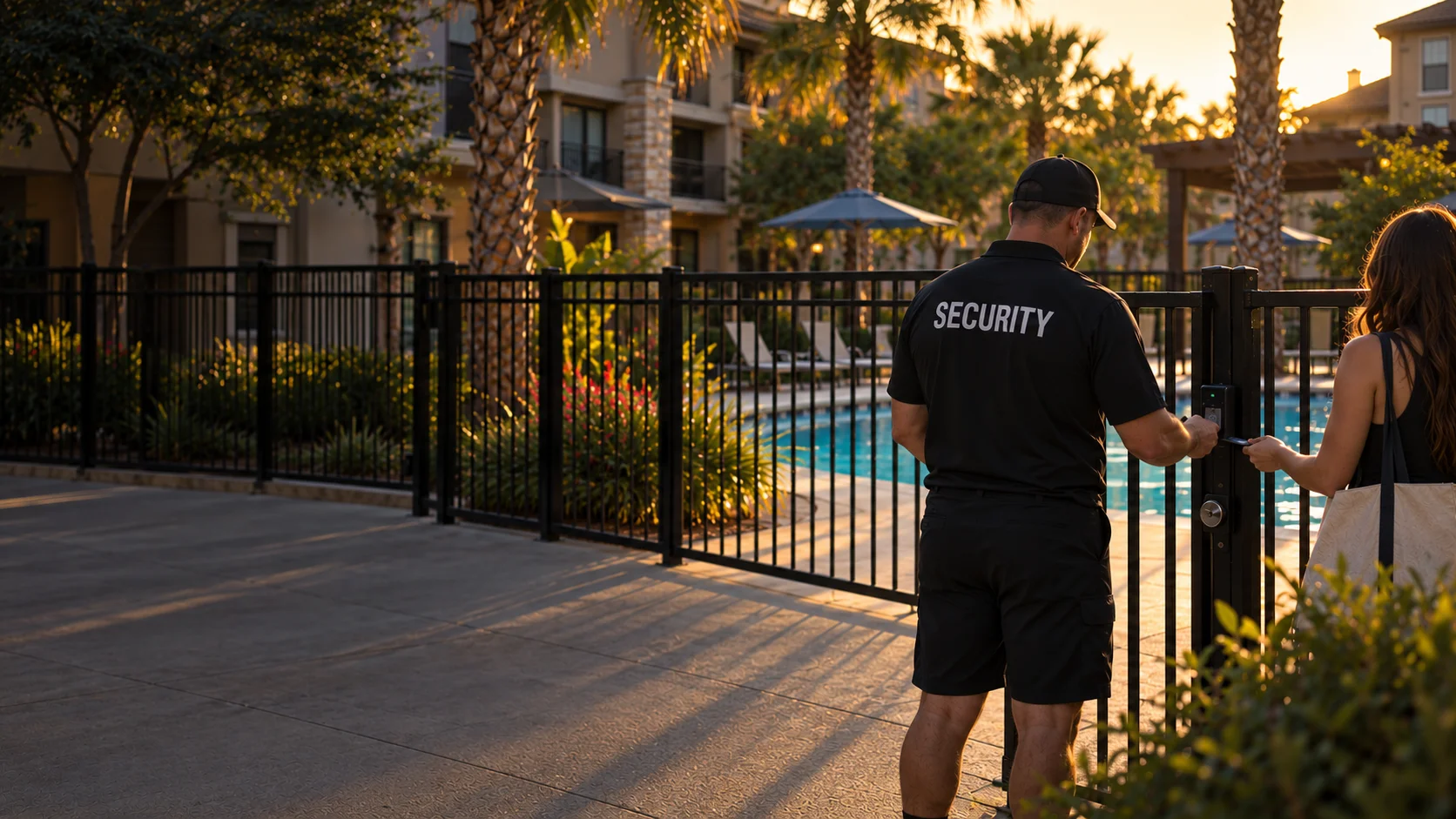
Every spring, the same request lands in security inboxes across Dallas-Fort Worth: a property manager needs "a lifeguard for the pool this summer." Nine times out of ten, what the property actually needs is a pool monitor, and the two words describe genuinely different jobs with genuinely different legal consequences. The distinction gets blurred because vendors blur it, RFPs blur it, and the person writing the request is usually solving for a different problem than the one the words describe. Getting it right matters, because the wrong choice can quietly shift liability onto the property that was trying to reduce it.
A lifeguard is trained and certified to perform water rescue and assumes a duty of care for the safety of people in the water. A pool monitor is a security officer who controls access to the pool area and enforces the posted rules, and assumes no rescue responsibility at all. One is an aquatics role. The other is an access control role that happens to take place next to water. They are not interchangeable, and a property that staffs one while describing it as the other has created a problem rather than solved one.
What Texas actually requires
Texas regulates public swimming pools under 25 Texas Administrative Code Chapter 265, Subchapter L, and the rules turn on how a pool is classified. Pools whose use is limited to residents or members, which covers apartment communities, condominiums, HOA neighborhood pools, and most hotel pools, fall into the Class C category. The affirmative lifeguard staffing requirements in those rules fall most heavily on other classes of pool. Class C pools are generally not required to provide a lifeguard at all.
What the rules do require of a facility that does not provide a lifeguard is a sign. It has to read WARNING - NO LIFEGUARD ON DUTY, and the letters have to be at least four inches high. The same safety provisions also call for rescue equipment to be present and reachable: a non-telescoping reaching pole at least twelve feet long with a shepherd's crook, and a Coast Guard approved ring buoy with a throwing rope, both visible and readily accessible from anywhere in the pool yard. If your property has let that signage fade or has quietly relocated the shepherd's crook into a maintenance closet, that is worth fixing before the question of staffing even comes up.
One caveat worth stating plainly: pool inspection and enforcement in Texas happen at the local health authority level, and requirements can be layered on by a county or municipality. Everything above is the state floor. Confirm the specifics with the health department that actually inspects your property before you treat it as settled.
Why the sign is the whole point
The four-inch sign looks like bureaucratic trivia until you understand what it is doing. It is a disclaimer of a duty of care. The property is telling every person who enters the pool yard, in letters large enough that nobody can claim they missed it, that supervision of swimmers is not being provided and that entering the water is the swimmer's own responsibility.
Now consider what happens when a property posts that sign and then stations someone at the pool in a swimsuit with a whistle and a red rescue tube. The sign says one thing and the staffing says another, and in the aftermath of a drowning or a serious injury, that contradiction is exactly where a plaintiff's attorney will spend their time. A property that voluntarily provides what looks like lifeguard supervision can find itself treated as having assumed the duty of care it posted a sign to disclaim, and then measured against the standard of a properly certified and properly staffed aquatics operation. That is a far worse position than either providing real certified lifeguards at real staffing ratios or providing none at all and saying so clearly.
This is why the presentation of pool staff is not a cosmetic question. A security officer in a uniform that reads as security, with no rescue equipment on their person and post orders that state in writing that they do not perform water rescue, is unambiguous. An "attendant" in beachwear is not.
What actually goes wrong at apartment and HOA pools
Here is the part that usually reframes the conversation. When property managers describe the problems their pool generated last summer, the list is remarkably consistent, and almost none of it is about swimming.
Guest limits get ignored, and a resident who is allowed two guests shows up with nine. Fobs and gate codes get shared until half the people at the pool do not live there. Non-residents walk in behind whoever opened the gate, which no fence or lock has ever prevented. Glass bottles come onto the deck. Alcohol appears at a pool where the community rules prohibit it. Furniture gets dragged around and damaged. Noise escalates on a Saturday afternoon until a resident calls the courtesy line. Unsupervised children are left at the pool by parents who have gone back to the unit. People come over the fence after the pool has closed for the night.
Every one of those is an access control problem or a rule enforcement problem. Not one of them is a rescue problem. And the incidents that actually turn into claims and lease disputes frequently come down to a question of who was allowed into the pool area and whether anyone wrote down what happened, rather than any question of anyone's swimming ability.
That is the case for a monitor. The job is to hold the gate, verify that the people entering are residents or properly counted guests, enforce the posted hours and the posted rules, and document incidents with photographs and a written report. The documentation is the part that gets undervalued. A dated, photographed log of a violation is what supports a lease enforcement action, an amenity privilege suspension, or an insurance claim months later when nobody's memory of a July afternoon is reliable any more.
The licensing question nobody asks
Texas Occupations Code Chapter 1702 defines guard company activity to include contractually performing services to prevent entry, trespass, or unauthorized activity on private property, and to observe or detect that activity. Read that against the job description above. A person stationed at a pool gate who verifies credentials, enforces guest limits, and turns away non-residents is performing those functions on a contract basis.
Whether any particular amenity staffing arrangement falls inside or outside Chapter 1702 is a determination for the Texas DPS Private Security Bureau and for your own counsel, and the statute contains exemptions. We are not going to tell you that a given vendor is operating unlawfully. What we will say is that the question is worth asking, because a property owner's exposure is not symmetrical. If the role is regulated and your vendor is unlicensed, that is your problem as much as theirs. If the role turns out not to be regulated and your vendor is licensed anyway, you have lost nothing.
So ask. Ask for the company license number, verify it through the Texas DPS Private Security Bureau, and ask whether the individuals assigned to your property are registered. Ask for a certificate of insurance and read the coverage limits. A licensed vendor will hand these over without friction.
What a monitor will not do
Scoping this correctly means being honest about the boundaries, and a vendor who will not state them is a vendor who is selling you something that does not exist.
A pool monitor does not perform water rescue. A pool monitor does not test or balance water chemistry, vacuum the pool, or restock restrooms; that is a pool management or janitorial contract, and a security company that quotes it is quoting work it is not equipped to do. And a staffed pool post covers the posted pool hours. When that shift ends, the officer secures the gate and leaves, and there is nobody on the deck.
That last one catches properties out. If your real problem is people coming over the fence at two in the morning, a daytime pool post does not solve it, and anyone who tells you otherwise is selling hours rather than solving the problem. Overnight trespassing is a mobile patrol problem: documented patrol visits on a randomized schedule through the overnight window, at a fraction of what extending a staffed post would cost. Plenty of DFW properties run both, a staffed post through posted hours and patrol visits after closing, and that combination is usually the right answer when the complaint log shows problems at both ends of the day.
How to scope pool coverage without overbuying
Start with the complaint log rather than with a schedule. Most properties discover their incidents concentrate hard into Friday evening through Sunday evening, plus the holiday weekends around Memorial Day, the Fourth of July, and Labor Day. Weekend-only coverage through the summer season solves the majority of the problem for a fraction of the cost of seven-day staffing, and it is the structure most DFW communities end up choosing once they look at when things actually happen.
From there the questions are simple. Which hours does the complaint history point to? Does the property need coverage for the full season or only the peak weeks? Is the problem concentrated at the gate, which argues for a post, or spread across the overnight hours, which argues for patrol? Armed coverage is rarely the right answer at a crowded family amenity, and a vendor who proposes it without a specific incident history behind the recommendation is not reading your property carefully.
Then ask the vendor the questions that separate the serious from the opportunistic. Are you licensed, and what is the number? Will your staff be presented as security rather than as lifeguards, and will the post orders say so? What does the daily report look like, and can I see a sample? What happens when an officer calls out sick on a Saturday in July? Who do I call at eight on a Sunday evening?
The property that asks those five questions in February gets a better summer than the property that hires the cheapest proposal in May.