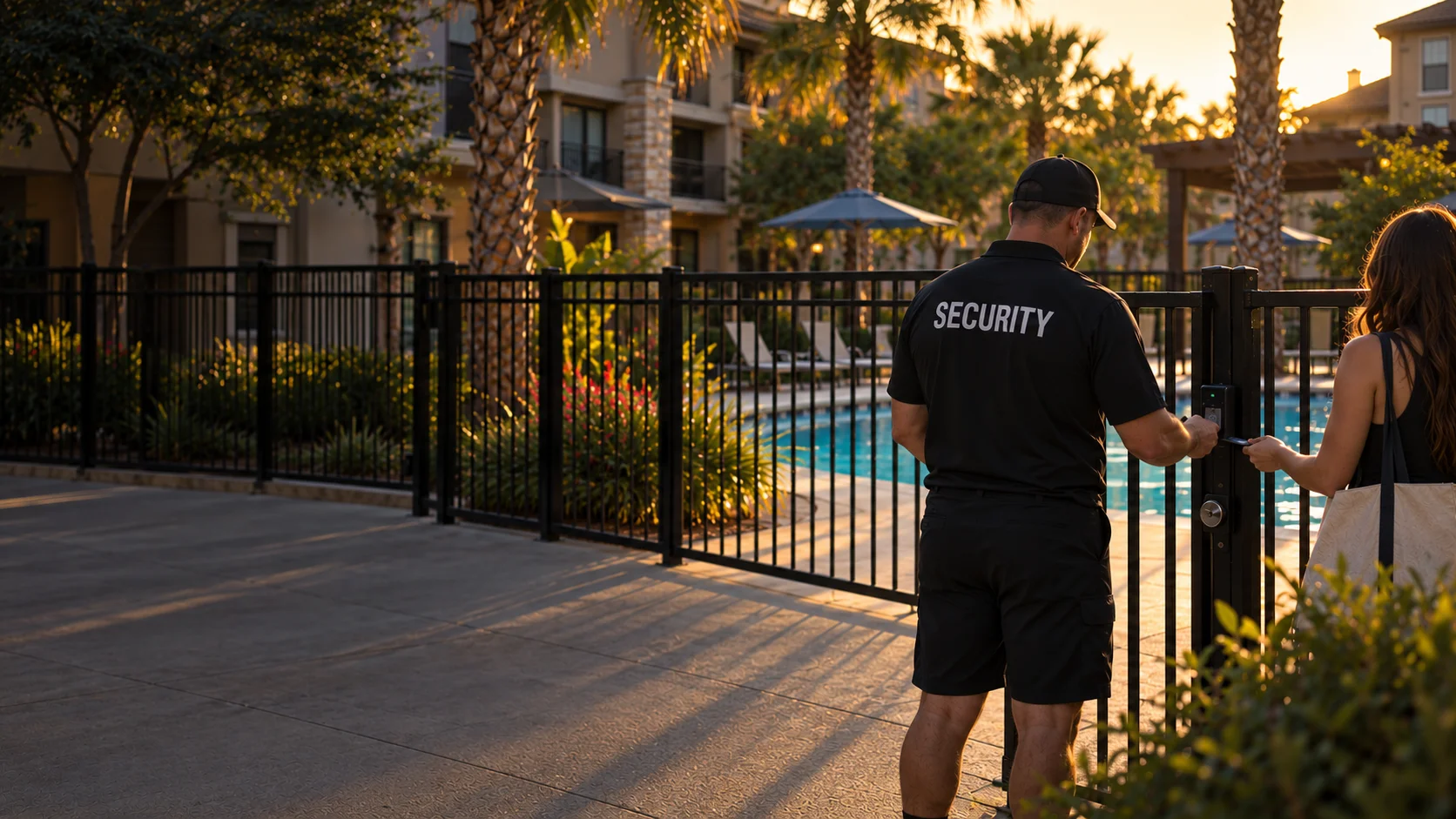
A negligent security claim is what happens when someone is hurt by a crime on your property and sues you instead of, or in addition to, the person who committed it. The theory is not that you did anything wrong in the moment. It is that the crime was foreseeable, that reasonable security measures would have reduced the risk, and that you did not take them. For apartment communities, retail centers, parking garages, hotels, and office buildings across Dallas-Fort Worth, this is the liability exposure that most often turns a single incident into a multi-year problem.
Before going further: this is a general overview written by a security company, not legal advice, and nothing here substitutes for your own counsel or your insurer's guidance. Premises liability is fact-specific and the outcomes turn on details. What follows is the shape of the thing, so you can have a more useful conversation with the people who do advise you.
The question Texas courts keep asking
Texas landowners generally owe a duty of reasonable care to people they invite onto their property, but that duty does not extend to protecting everyone from every conceivable criminal act by a third party. The hinge is foreseeability: was this kind of crime, in this place, reasonably foreseeable to the property owner?
Texas courts have approached that question by looking at the history of crime in and around the property rather than at the incident in isolation. The widely cited framework considers how close prior crimes occurred to the property, how recently they occurred, how often they occurred, how similar they were to the incident in question, and how publicized they were. A single unrelated incident three miles away five years ago does not make an armed robbery foreseeable. A documented pattern of violent crime in the parking lot over the preceding eighteen months is a different matter entirely.
The practical translation for a property manager is uncomfortable but clarifying. Your own incident history is the primary evidence of what you should have anticipated. The reports you filed, the police calls to your address, the complaints residents put in writing, the things your own staff documented: in litigation, that record is read back to you as proof of what you knew.
What plaintiffs actually point to
In practice, negligent security cases tend to converge on a short list of recurring facts.
The first is prior similar incidents that went unaddressed. Not that an incident happened, but that it happened, was known, and produced no change. Three vehicle break-ins in a parking garage followed by no additional lighting, no camera, no patrol, and no notice to residents is a far worse posture than three break-ins followed by a documented response, even if the response was modest.
The second is physical conditions that were reported and not fixed. Gates that stopped latching. Exterior lighting that had been out for months. A broken access door propped open as a matter of routine. Fencing with a known gap. These are concrete, photographable, and easy for a jury to understand, and work orders either exist or they do not.
The third is security that was promised and then quietly withdrawn. This one catches owners off guard. Marketing materials advertising a gated community, a courtesy patrol, or controlled access create expectations, and residents make decisions based on them. A property that advertises security and then cancels the contract without telling anyone is in a materially worse position than a property that never advertised it, because the claim becomes about reliance rather than just about risk.
The fourth is the absence of any record at all. A property that cannot produce incident reports, patrol logs, or any documentation of what it did and when is a property whose version of events rests entirely on memory, against a plaintiff with police reports and photographs.
The documentation problem
That last point is the one worth sitting with, because it is the most fixable and the most commonly neglected.
Most properties do more security work than they can prove. Patrols happen and nobody logs them. A manager responds to a complaint, handles it well, and writes nothing down. An officer runs off a group of trespassers at midnight and mentions it verbally at shift change. Eighteen months later, when it matters, none of it exists.
This is why a daily activity report is worth more than it looks. A dated, timed, photographed log of what was patrolled, what was observed, what was addressed, and what was escalated is not bureaucratic overhead. It is contemporaneous evidence created before anyone had a reason to shade the story, and in a dispute that is worth considerably more than a recollection assembled afterward. It cuts both ways, of course, which is exactly why it is credible.
It also does ordinary work long before litigation. The same documentation supports lease enforcement, justifies budget requests to an owner who wants to know why a patrol contract should be renewed, and gives an insurer something concrete during underwriting. Properties that keep good records tend to find out they had a developing problem while it was still cheap to solve.
Proportionality, not maximalism
None of this argues that every property needs armed officers or 24-hour security coverage. Courts ask what was reasonable given what was foreseeable, and an unreasonable response is its own kind of exposure. Armed guards at a quiet suburban office park with no incident history are not a liability shield; they are an expense, and in some settings they introduce risk rather than reducing it.
The defensible posture is a response proportionate to a documented risk picture. That usually means knowing your own incident history rather than guessing at it, fixing the physical conditions that keep appearing in complaints, matching coverage to when incidents actually occur rather than to a generic schedule, documenting what you do, and revisiting the assessment when the picture changes. A property that can show it looked at the problem, made a reasoned decision, and wrote it down is in a fundamentally different position from one that never looked.
It is also worth saying plainly that cameras are not a substitute. Recorded footage is useful after the fact and it deters some opportunistic crime, but a camera does not intervene, and a property that responded to a pattern of violent incidents by adding a camera and nothing else has frequently found that the footage became the plaintiff's most compelling exhibit rather than the owner's defense.
Questions worth asking before an incident
If you manage DFW property, a few questions are worth answering while they are still hypothetical. What has actually happened on this property in the last twenty-four months, and where is that written down? What have residents or tenants put in writing that has not been resolved? What does our marketing promise about security, and is it still true? If we were asked tomorrow to produce every patrol log and incident report from the last year, could we? And when did somebody last look at the incident pattern and make a deliberate decision about coverage, rather than renewing what was already in place?
Your attorney and your insurance carrier are the right people to take those answers to. The point of asking them early is that every one of them is cheap to fix before an incident and expensive to explain afterward.