Healthcare is one of the most violent industries in America to work in, not by reputation, but by the numbers. Healthcare and social service workers experience workplace violence injuries at rates several times the all-industry average, and the emergency department is the epicenter: a 24/7 open door that receives every psychiatric crisis, overdose, intoxicated injury, and family worst-day in its service area, staffed by clinicians whose job requires standing within arm's reach of all of it. Texas responded legislatively: since September 2023, state law (the workplace violence prevention statute enacted through Senate Bill 240) requires hospitals and certain other facilities to maintain a written workplace violence prevention plan and a committee to oversee it. Which means for Texas hospital and facility administrators, security is no longer just an operational question. It is a compliance obligation with a paper trail.
The law's structure matters for how security gets planned. The statute requires a written prevention plan grounded in an assessment of the facility's actual risk, unit by unit and shift by shift, along with training, incident response, and post-incident review. It does not prescribe a guard count, which is the point: it forces each facility to document its own risk honestly and defend its staffing decisions against that documentation. A hospital whose plan acknowledges high ED volatility on weekend nights and staffs nothing against it has written the plaintiff's exhibit itself. This is where contract security stops being a line item and becomes part of the compliance architecture: the coverage model has to match the plan, and the documentation the security team produces, from incident reports to patrol logs to response times, becomes the evidence that the plan is real.
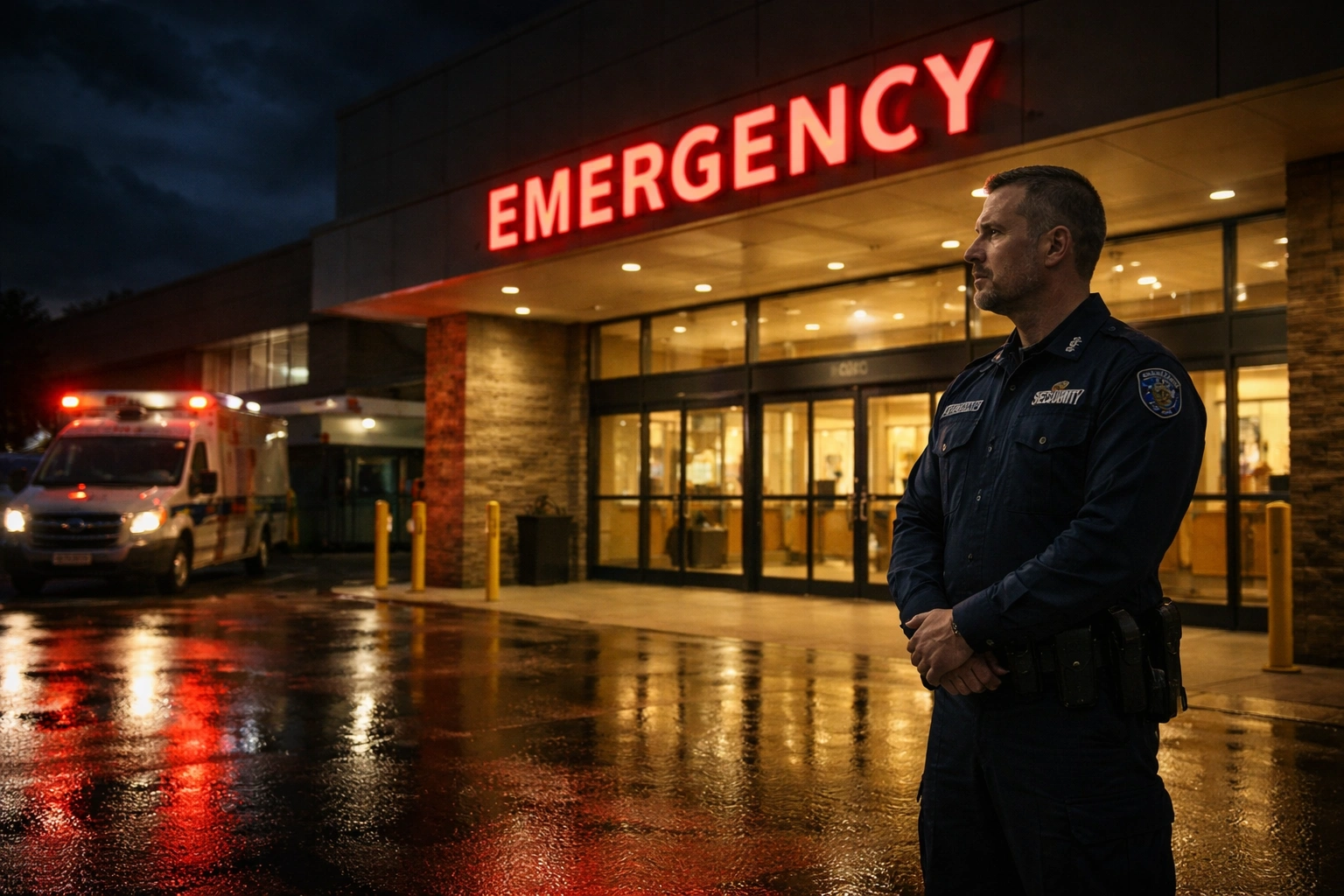
What makes healthcare security genuinely different from other commercial posts is that the "threat" is usually a patient in crisis or a family member in grief, and the mission is to protect staff without turning a hospital into a fortress. The emergency department officer's core skill is de-escalation: reading agitation early, creating space, lowering the temperature of an encounter that clinical staff need calmed rather than subdued. Physical intervention in a healthcare setting carries risks that don't exist at a warehouse gate: patients with medical conditions that make restraint dangerous, legal frameworks around patient rights, and clinical protocols that govern who may lay hands on a patient and how. An officer who treats an ED like a nightclub door is a liability generator. The right healthcare officer works as part of the clinical environment: known to the charge nurses, versed in the facility's restraint and behavioral-emergency protocols, and conscious that patient privacy rules shape everything from where incidents are discussed to how reports are written.
The coverage map of a hospital campus is wider than the ED. Access control after visiting hours, when a building designed to welcome the public has to become selectively permeable. Behavioral health units with elopement risks. Pharmacy areas with diversion exposure. Parking structures, which generate a disproportionate share of assaults and vehicle crime on any campus, and where staff walking to cars after night shifts are most exposed, are the reason escort programs are among the highest staff-morale-per-dollar services security provides. Infant security protocols in labor and delivery. Loading docks, morgue access, helipad operations during transports. And the forensic patient problem: individuals in custody brought in for treatment, where the handoff between law enforcement, corrections, and hospital security has to be choreographed in advance, not improvised at 2 AM. Smaller facilities, including freestanding EDs, surgery centers, clinics, and dialysis centers, face scaled versions of the same exposures, and the newer categories of the statute's coverage mean many are writing their first formal violence-prevention plans now.
Staffing models follow the risk assessment. Large hospitals typically run 24/7 posted coverage with dedicated ED officers and roving campus patrol, a model that demands roster depth, because a continuous post is a four-to-six officer rotation, and a hospital cannot tolerate the coverage gaps a thin roster produces. Mid-size facilities often combine a posted officer during high-acuity hours with mobile patrol coverage of parking areas and perimeter overnight. Clinics and outpatient centers may need presence during operating hours only, or event-driven coverage when a specific threat, such as a terminated employee or a volatile custody situation involving a staff member, elevates risk temporarily. The common thread is that the schedule should be derived from the facility's own incident data and documented in the prevention plan, because that is exactly what a regulator or plaintiff's attorney will compare against after an event.
Officer selection is the piece administrators underweight until it goes wrong. Healthcare posts need officers screened for temperament and trained specifically for the environment: de-escalation and behavioral crisis response, the facility's restraint policies, patient-privacy awareness, workplace violence typologies, and documentation standards that hold up in both regulatory review and litigation. Licensing in Texas runs under the Private Security Act (Occupations Code Chapter 1702), with commissioned Level III officers where the facility's risk profile justifies armed coverage, a decision that deserves genuine analysis rather than default in either direction. The armed question in healthcare is nuanced: many facilities run unarmed ED posts backed by armed roving supervisors or law-enforcement relationships, and the right answer is site-specific.
EJR Agency staffs healthcare security across the Dallas-Fort Worth metroplex, including hospitals, freestanding emergency departments, behavioral health facilities, surgery centers, and clinics, with officers selected and trained for clinical environments, under Texas DPS licensing. We build coverage plans that plug into your workplace violence prevention program: risk-assessment-driven post schedules, de-escalation-trained officers, documented incident reporting formatted for your committee, and the roster depth to run true 24/7 coverage without gaps. If your facility is standing up or upgrading its violence-prevention plan, call our 24/7 operations desk and we will walk the campus with you.