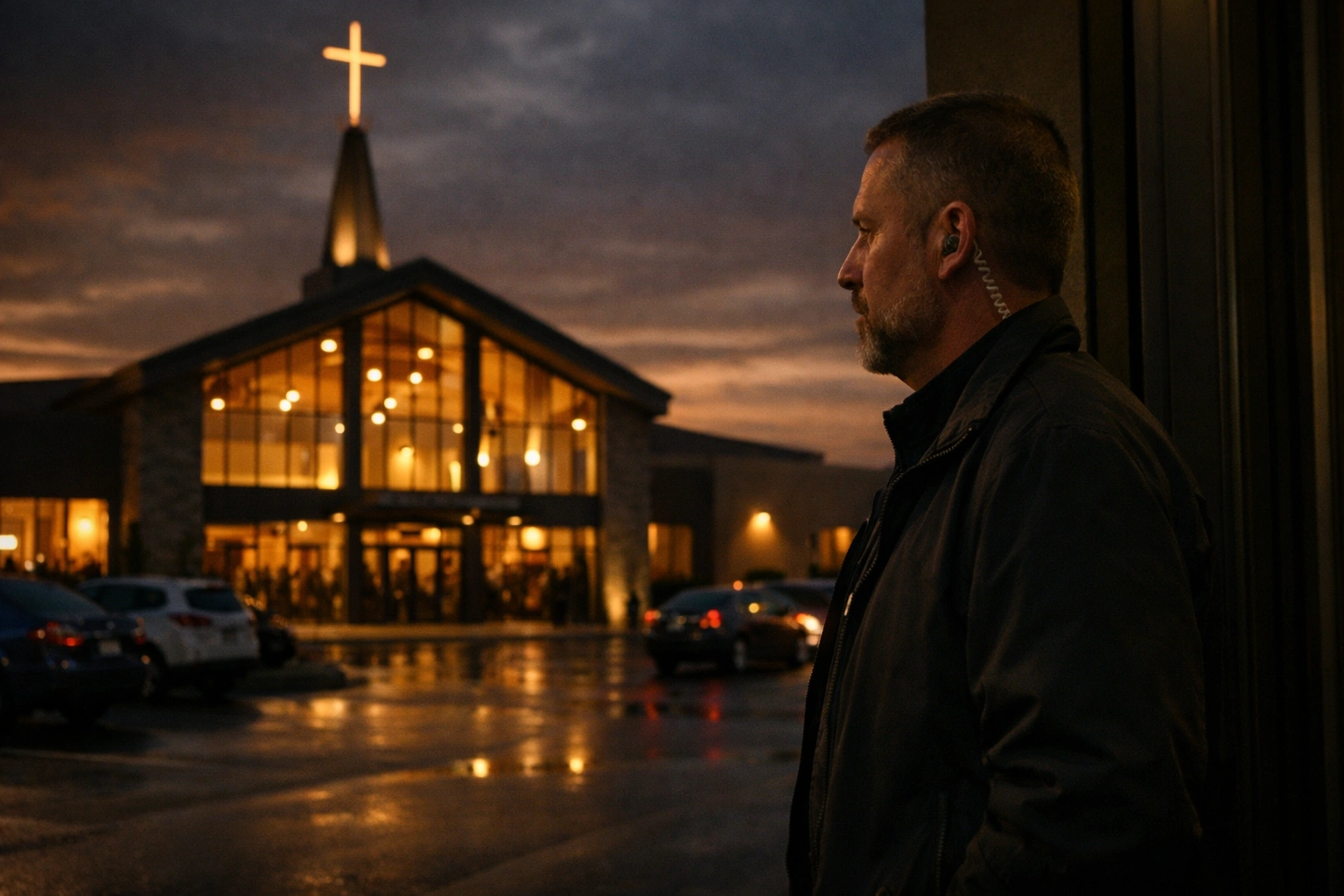
A house of worship is one of the hardest environments in all of private security to protect. The entire culture of a church, synagogue, mosque, or temple is built on openness: unlocked doors, a warm welcome to strangers, large gatherings on a predictable weekly schedule, and a sanctuary full of people whose attention is, by design, directed away from the entrances. Those same qualities are exactly what make a place of worship a soft target. Since the 2017 Sutherland Springs shooting in Texas, congregations across the state have moved security from an afterthought to a standing part of how they operate. For Dallas-Fort Worth congregations weighing how to protect their people, the questions almost always start in the same place: can we have armed security, who is allowed to carry, and where is the legal line?
The legal foundation in Texas shifted meaningfully in 2019. Following Sutherland Springs, the Legislature passed Senate Bill 535, which clarified that License to Carry (LTC) holders may lawfully carry in places of worship in Texas; a place of worship is not automatically off-limits the way some assumed. A church can still choose to prohibit carry by posting proper legal notice (the 30.06 sign for concealed carry and the 30.07 sign for open carry), but absent that posting, licensed carry is generally permitted. The practical takeaway for leadership is that the decision belongs to the congregation: you can permit responsible licensed carry, or you can prohibit it with correct signage, but you should make that decision deliberately, post clearly either way, and communicate it to your members rather than leaving it ambiguous.
The more common point of confusion is the difference between a volunteer safety team and licensed security. These are not the same thing under Texas law, and treating them as interchangeable is where churches get into trouble. Providing security services for compensation in Texas is regulated under the Private Security Act (Texas Occupations Code Chapter 1702) and requires Department of Public Safety licensing. A church that hires guards needs licensed officers, and for armed coverage, that means Level III or Level IV commissioned security officers. A volunteer safety team made up of unpaid congregation members watching over their own church operates under different rules, but it also operates under real limits, particularly once members are armed or are held out to the public as the church's "security." The line between a volunteer keeping watch and an unlicensed person performing paid security work is one every congregation should walk through with its own attorney rather than assume.
This is why the armed role specifically belongs with a licensed, commissioned officer. A congregant with a License to Carry and a licensed Level IV commissioned security officer are not the same thing, even if both are lawfully armed. The commissioned officer is trained in threat assessment, de-escalation, use-of-force decision-making under stress, and the legal aftermath of a defensive action, and critically, carries the licensing and insurance that put the liability where it belongs. When something goes wrong at a church, the liability question lands on the church. A trained, licensed, insured officer is the difference between a defensible security posture and an improvised one that exposes the congregation to enormous risk.
The model that works best for most DFW congregations is layered rather than all-or-nothing. At the center is one or more licensed officers, armed or unarmed depending on the congregation's risk assessment, positioned at the main entrances and circulating during services. Around that core sits a trained volunteer safety team handling the things volunteers do well: greeting and reading the room, watching the parking lot, managing access to children's areas, and maintaining a simple radio or communication protocol so that anything unusual reaches the officer immediately. Greeters and ushers become the eyes; the licensed officer is the trained response. That combination protects the congregation without turning the front door into a checkpoint or sacrificing the welcome that defines the place.
The threats churches actually face are broader than the active-shooter scenario that drives most of the conversation. Far more common are service disruptions, domestic disputes that follow a family into the building, theft of offerings and audiovisual equipment, and incidents in and around the parking lot, where a large share of real-world confrontations begin before anyone reaches the sanctuary. Children's ministries and nursery areas carry their own access-control requirements. And the highest-attendance services of the year, including Easter, Christmas Eve, high holy days, funerals for prominent members, and special events, concentrate risk precisely when the building is fullest and the volunteer team is most stretched. Those are the windows where a licensed officer presence matters most.
Security also cannot be a Sunday-only consideration. Most houses of worship are busiest on one or two days a week but open and lightly staffed for far more, including weekday offices, daycares and schools, food pantries, recovery groups, community meetings, and youth events. A church office with one administrator on a Tuesday afternoon, or a daycare wing operating midweek, can be more exposed than a packed Sunday sanctuary. A serious protection plan accounts for the full operating week, including mobile patrol checks during off-hours and clear access-control procedures for the times the building is open but quiet.
Building the plan starts with an honest assessment: entrances and sightlines, the parking lot, children's areas, the flow of a typical service, the carry-posting decision, and coordination with local law enforcement. From there it becomes a written set of procedures, a defined role for licensed officers, a trained and bounded volunteer team, and drills so that the plan is something the congregation has practiced rather than just filed. EJR Agency has protected Dallas-Fort Worth properties since 1983, and we bring that experience to congregations building church security that fits both the threat profile and the character of the place. For licensed armed or unarmed church security, parking-lot and event coverage, or a full assessment of your facility, our 24/7 operations desk can begin a site walkthrough and a protection plan built around your congregation.