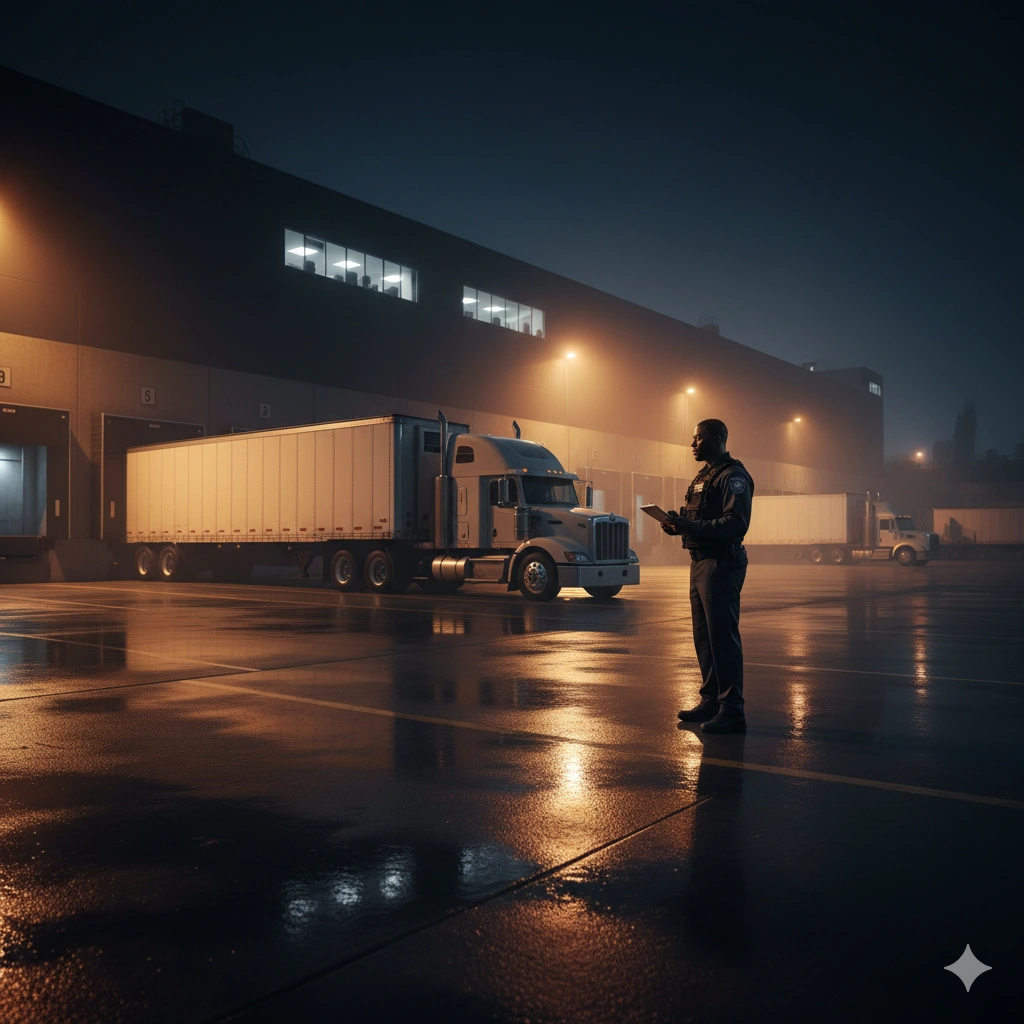
Ask a property manager when their building is most vulnerable and most will describe a time of day. The honest answer for a lot of Dallas-Fort Worth commercial property is a time of year: the stretch from the Wednesday before Thanksgiving through the first week of January, when a distribution center runs a skeleton crew, an office tower empties out, a construction site goes dark for two weeks, and a manufacturing facility shuts down entirely. For many properties this is the longest continuous period all year that nobody who works there is on site.
That window matters more than its length suggests, because an occupied building is doing a lot of security work that nobody credits it for. Employees notice the door that will not latch. A delivery driver notices the truck parked behind the building that does not belong. A supervisor notices that the gate was left open. Strip the people out for ten days and all of that incidental observation disappears at once. What remains is whatever you deliberately put in place.
What actually changes when a property goes dark
The first change is detection time. During normal operations, a break-in is often discovered within hours because somebody walks past the damage. During a shutdown, the same break-in can go unnoticed until the first person returns, which might be a week later. That gap is what turns a smash-and-grab into a methodical removal of anything worth money, sometimes across multiple visits, because whoever got in the first time has learned that nobody is coming.
The second change is alarm response. Alarm systems do not stop working during a holiday, but the human chain behind them degrades. Call lists route to people who are out of state. Keyholders who normally respond in fifteen minutes are three hours away. False alarms from HVAC cycling or a door seal shifting in a cold snap get acknowledged and dismissed without anyone physically checking, and after the third one nobody is treating the fourth seriously. A monitoring contract is only as good as the person who shows up, and over a holiday that person is frequently nobody.
The third change is response priority. Dallas-Fort Worth police departments do not stop working either, but holiday weekends bring call volume that pushes a commercial burglary alarm with no confirmed entry down the list. The practical result is that a property relying on alarm-plus-police during a shutdown is relying on the slowest version of that chain.
And the fourth is simply that the people who target commercial property know all of this. The shutdown calendar is not a secret. A construction site with no deliveries scheduled, a dark office floor, a lot with no cars in it for four consecutive days: these are legible from the street.
The properties that feel it hardest
Construction sites are the clearest case. A site that shuts down for two weeks is sitting on copper, wire, tools, fuel, and unsecured material in a configuration that changes weekly, which means the security plan that worked in October may not match the site in December. Copper and catalytic converters remain the most liquid theft targets in the metroplex, and a dark site with no scheduled activity is the easiest version of that job.
Distribution and warehouse facilities carry the opposite problem: peak inventory. A facility that ran lean in September is holding its highest-value stock of the year right as it drops to a skeleton crew. Trailers staged in the yard are effectively unattended storage units.
Office and medical buildings face less inventory risk but more access risk. Cleaning crews, contractors doing work while tenants are away, and vendors with holiday schedules all move through a building when almost nobody is around to question them. Copper, AV equipment, and anything in an unlocked suite tends to walk during exactly these weeks.
Retail centers invert the pattern. Their stores are busier than ever while the common areas, parking lots, and service corridors absorb far more foot traffic than usual, which raises both theft and liability exposure at the same time.
Why October is when this gets decided
Here is the practical reason to think about this now rather than in December. Holiday coverage is a staffing problem before it is a security problem. Guards have families and holiday plans like anyone else. The officers who are willing to work Christmas Eve overnight get committed early, and a licensed security company staffs those shifts from a finite roster that fills on a first-come basis.
A property that calls in the second week of December is not choosing from the same pool as a property that booked in October. It is choosing from whatever is left, which frequently means a less experienced officer, an officer unfamiliar with the site, or no availability at all. The quality gap between booking early and booking late is wider for holiday coverage than for any other kind of contract we staff.
There is also a site-knowledge argument. An officer who has walked your property before the shutdown knows which doors stick, which lights are out, which gate code works, and who the legitimate after-hours vendors are. An officer dropped onto an unfamiliar site on December 23rd knows none of that, and the shutdown is the worst possible time to learn.
How to scope it without overbuying
Start by being specific about what the dark window actually is. Most properties discover it is not a continuous two weeks but a pattern: fully closed for four or five days around Thanksgiving, reduced staffing through mid-December, fully closed from roughly December 24th through January 2nd, with a couple of skeleton-crew days scattered in. Coverage should follow that shape instead of a flat block.
From there the choice is between a staffed post, mobile patrol, or a combination. A staffed post gives you continuous security coverage through the dark window, and makes sense where there is a specific high-value concentration to protect and where that unbroken presence is itself the deterrent, which is the usual answer for construction sites holding material and for facilities with yard-staged inventory. Mobile patrol makes sense where the risk is spread across a large footprint or multiple properties, and where documented randomized visits through the overnight window are enough to break the pattern someone is watching for. Many portfolios run both: a staffed post at the one or two properties with real exposure, patrol routes across the rest.
Access control deserves its own thought even when the building is closed. Shutdowns are when contractors do disruptive work, and a written list of who is authorized to be on site during the dark window, with approximate times, is the single most useful thing a property manager can hand a security vendor. Without it, an officer has no basis for distinguishing a legitimate HVAC crew from someone with a van and a confident manner.
What to hand your vendor before the window opens
A shutdown contract works or fails on information that takes twenty minutes to assemble and that almost nobody assembles. Your vendor should have a current contact tree with real cell numbers and a stated order of escalation, including who to call at two in the morning on Christmas Day and who to call if that person does not answer. They should have the alarm company name and account details, the list of authorized vendors and contractors with expected dates, known problem areas from the last twelve months, and clear instructions on what an officer should do versus what should trigger a call to you or to police.
They should also have written post orders specific to the shutdown rather than a copy of the normal ones, because the normal ones assume occupants. Patrol routes change when a building is empty. Interior checks that are impossible during business hours become possible and valuable. The escalation threshold usually drops, because during a shutdown almost any human presence is worth a report.
Finally, plan the return. The first walkthrough after a shutdown should be deliberate rather than incidental: doors and locks, lighting, fence line, roof access points, and a comparison against the daily reports from the window. Problems found in the first hour back are problems you can still document for an insurer. Problems found in March are problems you are paying for yourself.
The properties that come through the holidays without an incident are rarely the ones that spent the most. They are the ones that decided in October what the dark window looked like, told somebody about it, and wrote down who to call.