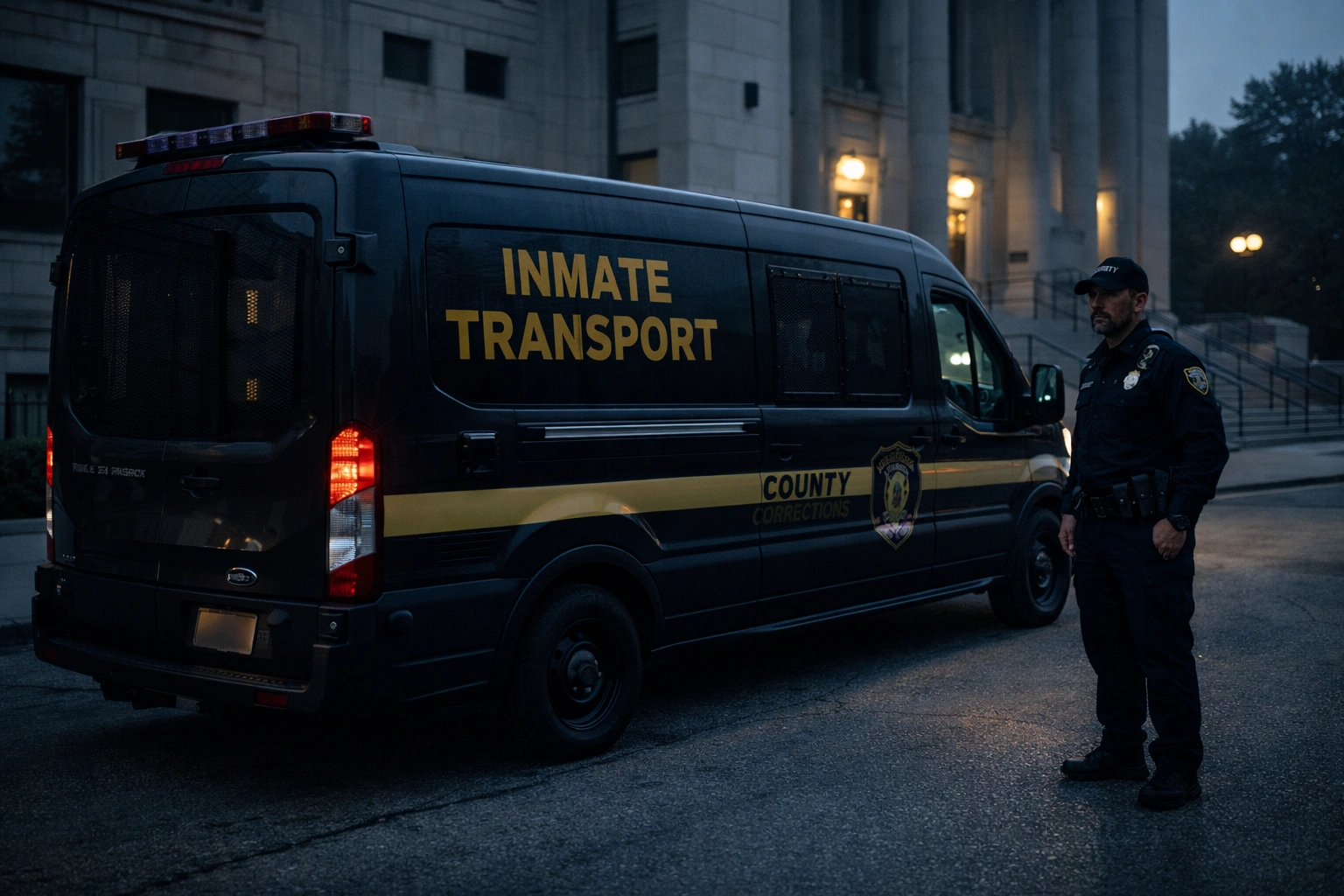
Transporting inmates between facilities, courthouses, and jurisdictions is one of the most high-stakes operations in the criminal justice system. A single failure in protocol can result in escapes, injuries, legal liability, and public safety emergencies. For courts, correctional facilities, and attorneys across Texas, private inmate transport companies provide a critical service — but not all providers operate at the same standard.
The federal government regulates private prisoner transport through the Interstate Transportation of Dangerous Criminals Act of 2000, also known as Jeanna's Act, and the corresponding federal regulations under 28 CFR Part 97. These standards establish minimum requirements that any company transporting violent prisoners in or affecting interstate commerce must meet. They are not optional guidelines — they carry the force of federal law.
Under these federal regulations, transport officers must complete a minimum of 100 hours of training before they are permitted to transport violent prisoners. That training covers restraint techniques, use of force policies, search procedures, firearms handling, CPR and first aid, defensive driving, and map reading and navigation. Companies that cut corners on training expose themselves — and their clients — to enormous liability.
Staffing ratios are federally mandated as well. At least one officer must be on duty for every six violent prisoners being transported. For high-risk transports or long-distance moves, responsible companies staff above this minimum. The guard-to-prisoner ratio directly impacts safety outcomes, and courts evaluating transport providers should ask specifically about staffing standards.
Every transport officer must pass a thorough background check before employment. Federal regulations disqualify anyone with a prior felony conviction or any state or federal conviction for a misdemeanor crime of domestic violence. Pre-employment drug testing is also mandatory, with a failed test serving as an automatic bar to employment. These aren't company policies — they're federal requirements.
Restraint protocols are spelled out clearly in federal standards. Violent prisoners must be secured with leg shackles and double-locked handcuffs when appropriate. The type and level of restraint should be based on the individual's classification, history, and the specific circumstances of the transport. Proper restraint reduces risk for officers, the public, and the inmates themselves.
Chain-of-custody documentation is the backbone of professional inmate transport. Every transfer must produce a documented record showing exactly when custody was assumed, the condition of the inmate at pickup, every stop made during transport, and the exact time and circumstances of delivery. This documentation protects the transport company, the sending facility, and the receiving facility. Without it, liability gaps emerge that can be exploited in litigation.
Notification requirements add another layer of accountability. When transporting violent prisoners, companies are required to notify local law enforcement officials 24 hours in advance of any scheduled stops in their jurisdiction. In the event of an escape, immediate notification to local authorities is mandatory. These protocols exist to protect communities along transport routes.
Insurance is a critical differentiator between professional transport providers and fly-by-night operations. Industry standards call for a minimum of $3 million in commercial general liability coverage including excess umbrella coverage, in addition to mandated auto liability insurance. Any company operating with less coverage is transferring risk to their clients — the courts and facilities that hired them.
The Federal Motor Carrier Safety Administration requires any company in the business of transporting inmates to obtain a USDOT number and comply with all applicable federal motor carrier regulations. This includes vehicle maintenance standards, driver qualification files, hours-of-service compliance, and drug and alcohol testing programs. A professional transport company maintains full FMCSA compliance as a baseline, not an afterthought.
For Texas courts and correctional facilities, hiring a private transport company offers significant operational advantages. County sheriff departments often lack the personnel to pull deputies off patrol for multi-day transport runs. Private transport eliminates that staffing burden while providing officers who specialize in secure custody movement. Court schedules stay on track. Facility transfers happen on time. And chain-of-custody documentation meets the evidentiary standards that attorneys and judges expect.
EJR Agency provides licensed, insured inmate transport services across Texas and nationwide. Our transport officers exceed federal training requirements, maintain full chain-of-custody documentation on every move, and operate under comprehensive insurance coverage. Local courthouse runs, interstate facility transfers, or emergency transport — our operations desk coordinates it all. Call 24/7 to schedule.