Planning security for a large event in Dallas-Fort Worth requires more than hiring a few guards and hoping for the best. Between municipal permit requirements, staffing calculations, coordination with local law enforcement, and the logistics of crowd management, event security is a discipline that demands professional planning and execution. Getting it wrong doesn't just create inconvenience — it creates liability.
The foundation of any event security plan is a thorough risk assessment. This means evaluating the venue's physical layout, the expected attendance, the event type and audience demographic, whether alcohol will be served, the time of day, weather considerations, and any known threat factors. A corporate fundraiser at a hotel ballroom carries fundamentally different risk than an outdoor music festival with general admission and alcohol sales. The security plan must reflect those differences.
Staffing ratios provide the baseline for security planning. The general industry guideline is one security officer per 100 attendees for standard, low-risk events. But this baseline shifts dramatically based on circumstances. Events serving alcohol should plan for substantially higher staffing — events with young adults and alcohol may need up to three times the baseline ratio. Outdoor events with multiple entry points need additional personnel at each access point, where bag check throughput averages 200 to 300 people per lane per hour, creating potential bottleneck delays that must be built into the event timeline.
For events exceeding 250 attendees with at least four entry points, detailed staffing models recommend 30 or more security officers to maintain adequate coverage across access control, interior patrol, perimeter security, and emergency response positions. Events exceeding 50,000 attendees require a comprehensive structured security plan coordinated with municipal authorities.
Dallas and Fort Worth each have specific requirements for large events. The City of Dallas requires a Special Event Permit for large gatherings on public property or any event that impacts traffic and public safety. This permit application must include a detailed security plan outlining staffing, access control, emergency procedures, and coordination with the Dallas Police Department. Fort Worth maintains a Special Events and Emergency Response unit that handles similar coordination.
Both the Dallas Police Department and Fort Worth Police Department operate formal off-duty officer programs. Event organizers can hire off-duty officers through the department's coordination office to supplement private security. These officers maintain their law enforcement authority, providing arrest capability and direct communication with on-duty dispatch. Rates are typically set by the department rather than negotiated individually, and officers must be hired through the department's program rather than directly.
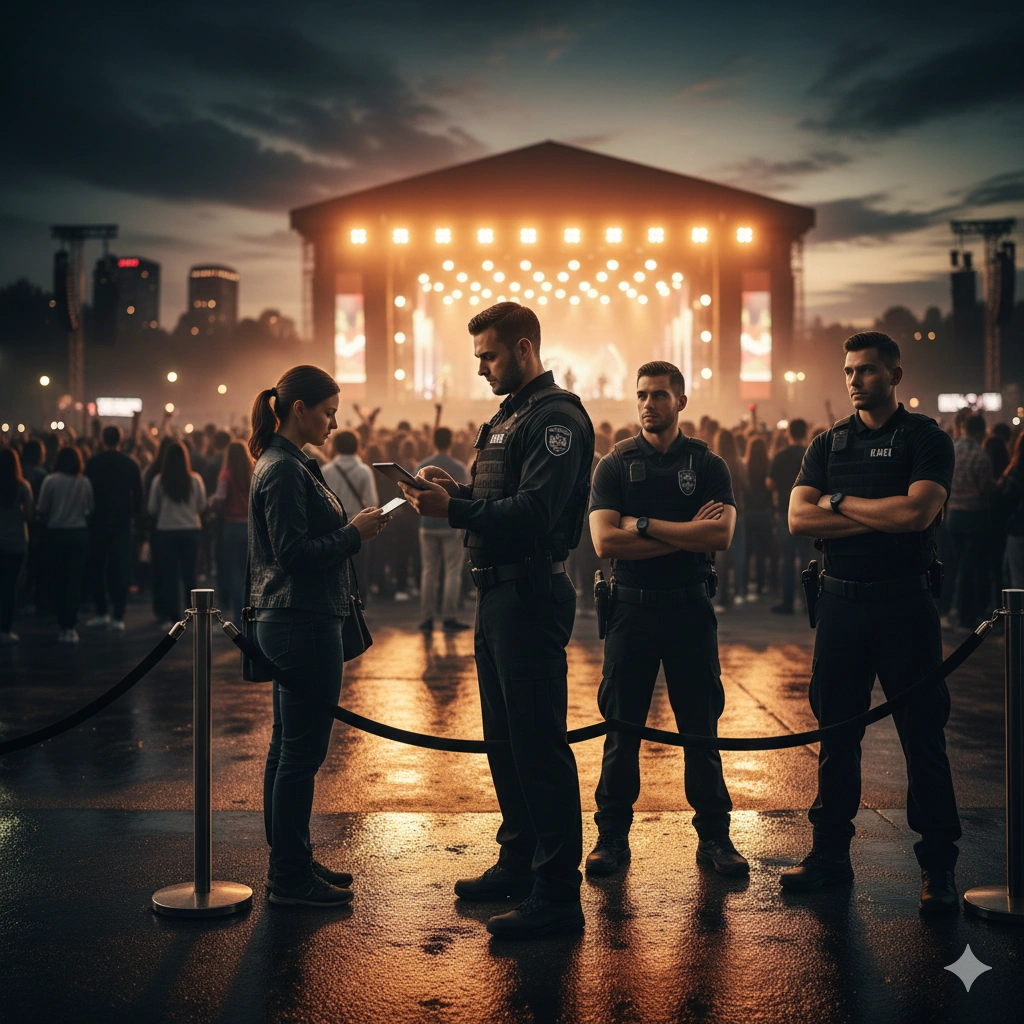
Access control is where most event security plans succeed or fail in practice. Every entry point needs defined procedures for ticket verification, credential checking, bag inspection, and prohibited item screening. Queuing areas must be designed with adequate space and weather protection. VIP access, media credentials, vendor entry, and staff access should use separate lanes to prevent bottlenecks at general admission points.
Alcohol management requires dedicated attention at any event where beverages are served. This includes monitoring for overconsumption, implementing cut-off protocols at a designated time before the event ends, staffing dedicated officers in alcohol service areas, and ensuring that ID verification is consistently enforced. Events serving alcohol consistently generate higher rates of altercations, medical calls, and ejections.
Emergency evacuation planning is non-negotiable for any large event. Pre-planned evacuation routes must be established and communicated to all security personnel. Trained staff should be positioned at every exit. Clear signage and public address capability must be in place. Venue occupancy limits set by fire code must be strictly enforced with real-time counting at entry points.
North Texas adds a weather dimension that event planners in other regions may not face. Severe thunderstorms, including hail and tornadoes, are a real possibility during spring and fall event seasons. Lightning protocols — including specific distance thresholds that trigger evacuation from outdoor areas — should be established before the event and communicated to all security staff.
EJR Agency provides professional event security across Dallas-Fort Worth for events of all sizes. Our team handles threat assessment, staffing planning, access control, crowd management, and coordination with local authorities. Licensed, insured officers — armed or unarmed based on event requirements. Contact our operations desk to begin planning your event security.