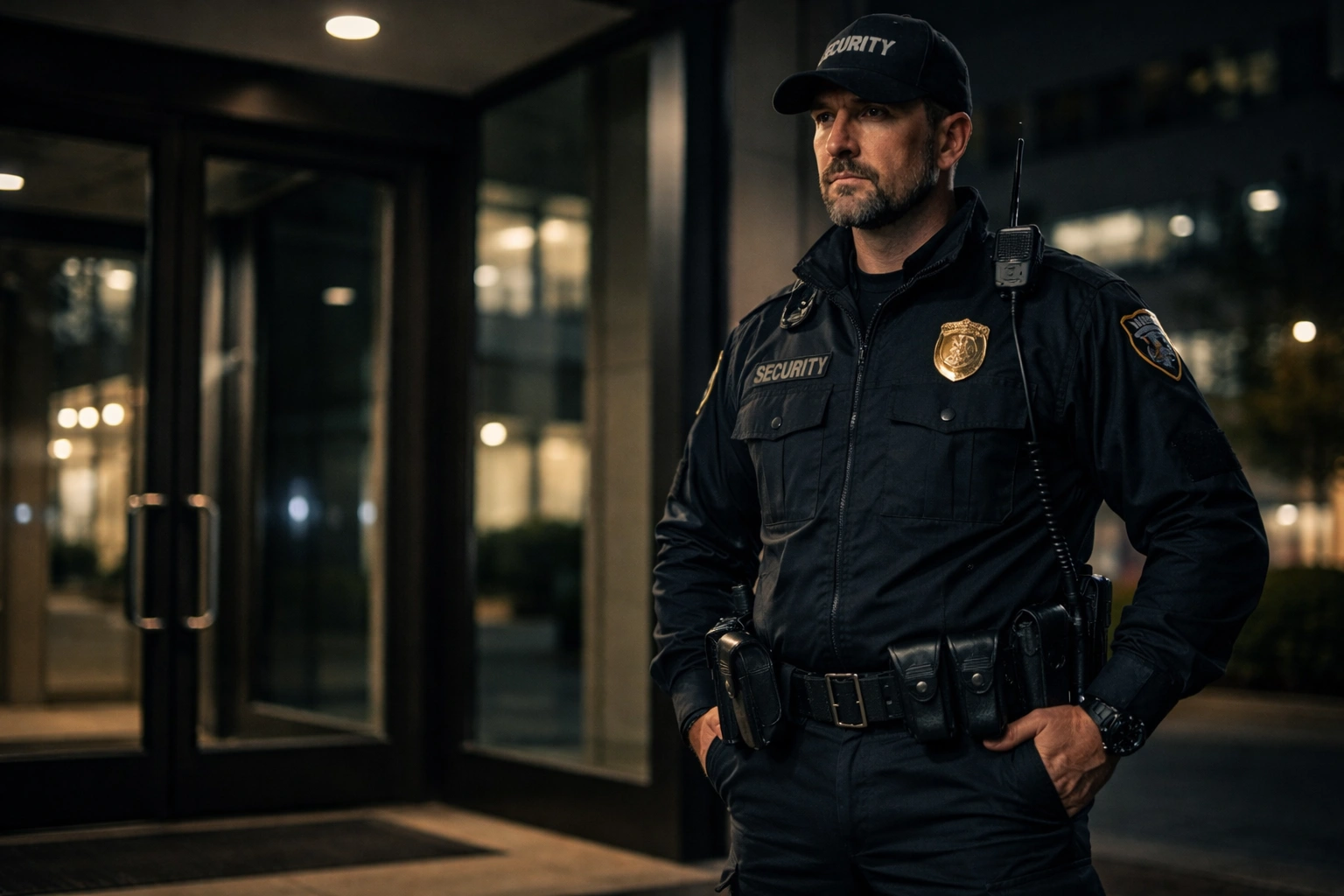
When a property manager asks for a guard "around the clock," the request sounds like one job for one person. The arithmetic says otherwise, and the arithmetic is worth walking through, because it explains almost everything about how 24/7 security contracts are priced, why some security companies fail at them, and what you should ask any vendor before signing one. A 24/7 post is 168 hours of coverage every week: 24 hours times 7 days. A full-time officer works 40 hours. Divide one by the other and a single continuous post consumes 4.2 full-time officers' worth of hours before a single day of vacation, a single sick call, or a single training day enters the picture.
That 4.2 is the floor, not the answer. Real officers take time off: vacation, illness, family emergencies, firearms requalification for commissioned officers, mandatory training. Across a year, that reliably absorbs a meaningful slice of scheduled hours, which pushes the true requirement past the raw 4.2 FTE. Add the handoff overlap that professional coverage requires, with the incoming officer arriving before the outgoing officer leaves at every shift change, three or four times a day, every day, and the practical answer lands where EJR Agency has staffed it since 1983: a single 24/7 post takes a rotating roster of four to six trained, licensed officers. Not one guard. Not two guards splitting long shifts until they burn out. Four to six.
How those hours divide across the day matters too. The most common structure is three eight-hour shifts per 24-hour cycle (morning, afternoon, overnight), which maps cleanly onto full-time schedules and gives each officer a consistent rhythm. Some posts run better on four six-hour shifts, particularly where the work demands sustained attention: dense visitor traffic, active access control, environments where a fatigued officer at hour seven is a liability. Shorter shifts cost more coordination, four handoffs a day instead of three, but fatigue is a real security variable, not an HR nicety. An alert officer at hour three of six catches what a tired officer at hour eleven of twelve walks past, which is exactly why the twelve-hour-shift, two-man "coverage" some vendors quote is a red flag rather than a bargain.
The shift change itself is where thin rosters get exposed. Every handoff on a properly run post is structured: the incoming officer arrives on site before the outgoing officer departs, the shift's events are briefed, post orders are reviewed, open issues are documented, and only then does the outgoing officer sign off. That overlap is unpaid-for minutes on a spreadsheet and the entire point in practice. Without it, every shift change is a scheduled, predictable gap, and predictable gaps are precisely what opportunistic theft exploits. A contractor who has watched a site for a week knows exactly when the 11 PM guard drives off before the midnight guard arrives. Overlap is what makes 24/7 coverage actually continuous instead of technically continuous.
Then there is the layer the arithmetic doesn't show: supervision. A roster of five officers cycling through a post needs someone verifying that post orders are followed at 3 AM, that the overnight officer is alert and on post, that handoffs are actually happening as documented. Professional 24/7 contracts build in unannounced supervisor visits at randomized intervals, including overnight and during shift changes, the two windows where corner-cutting concentrates. An officer who knows a supervisor may appear at any hour runs the post differently than one who knows nobody is checking. When you price 24/7 coverage, the supervisor layer is part of what separates a real continuous-coverage operation from an hourly body in a uniform.
This math is also why vendor depth matters more for 24/7 contracts than for any other coverage model. A security company with a thin officer pool can usually survive a single-shift contract: one post, one officer, a backup or two. Stretch that same pool across 168 weekly hours and the failure modes arrive on schedule: a sick call with no qualified replacement becomes an uncovered overnight; vacation season becomes a month of double shifts and a fatigued, resentful roster; one officer quitting becomes a scramble that ends with an unfamiliar, unbriefed guard on your property. The properties that depend on continuous coverage, including construction sites in the high-theft finish phase, hospitals, distribution centers, and multifamily communities, are exactly the properties where those failure modes do real damage.
The math also explains 24/7 pricing in a way that makes vendor quotes easier to read. A continuous contract is a volume commitment, 168 hours a week, so the per-hour rate typically lands below ad-hoc or short-term hourly rates, but the monthly total reflects that you are funding a five-officer rotation, handoff overlap, and a supervisor layer, not a single salary. A quote dramatically below market for "24/7 coverage" is answering a different question than the one you asked: it is quoting fewer officers stretched thinner, twelve-hour shifts, no overlap, or no supervision. The discount is coming out of the roster, and the roster is the product.
So before signing a 24/7 contract with anyone, including us, ask the roster questions. How many officers are assigned to my post's rotation? What happens at shift change, specifically? Does the incoming officer arrive before the outgoing officer leaves? Who covers a 2 AM sick call, and how fast? How often does a supervisor visit unannounced, and do those visits include overnights? What documentation does each shift produce, and when do I see it? A vendor running the model properly answers all five without hesitation, because the answers are the operation. EJR Agency has staffed 24/7 posts across the Dallas-Fort Worth metroplex on exactly this math since 1983, with four-to-six officer rotations, structured handoffs, unannounced supervision, and digital daily activity reports on every shift, and a new post typically goes live within 48 to 72 hours of the first call. Our 24/7 operations desk can walk your property and show you the roster plan before you commit to anything.